Care guide · Dogs · 9 steps
How to measure your dog for a harness
When a harness twists to one side on walks or pinches under the front legs, the size is the first thing to check. The next chart you open will ask for your dog's chest, and sometimes the neck as well. With a soft tape and a pocket of treats, you can have both numbers in a few minutes.

Quick answer
Get your dog standing and put a soft tape around the ribcage, where your harness's size chart says to measure, with room for two fingers underneath. If the chart gives a neck size too, measure the neck too, low down where a collar would sit. Then look up your numbers on that same chart, and follow the brand's advice if you land between two sizes.
See all 9 steps ↓Step by step
Grab a soft tape
A cloth sewing tape bends around your dog's ribs. If you don't have one, wrap a shoelace around instead, pinch where it overlaps, and lay it on a ruler.
Read the brand's chart
Open the size chart for the harness you want and find its measuring line. Brands don't all tape the chest in the same place, so check where this one does.
Get your dog standing
A dog who sits or leans throws off the number, so wait until they're standing square on all four feet.
Find the spot
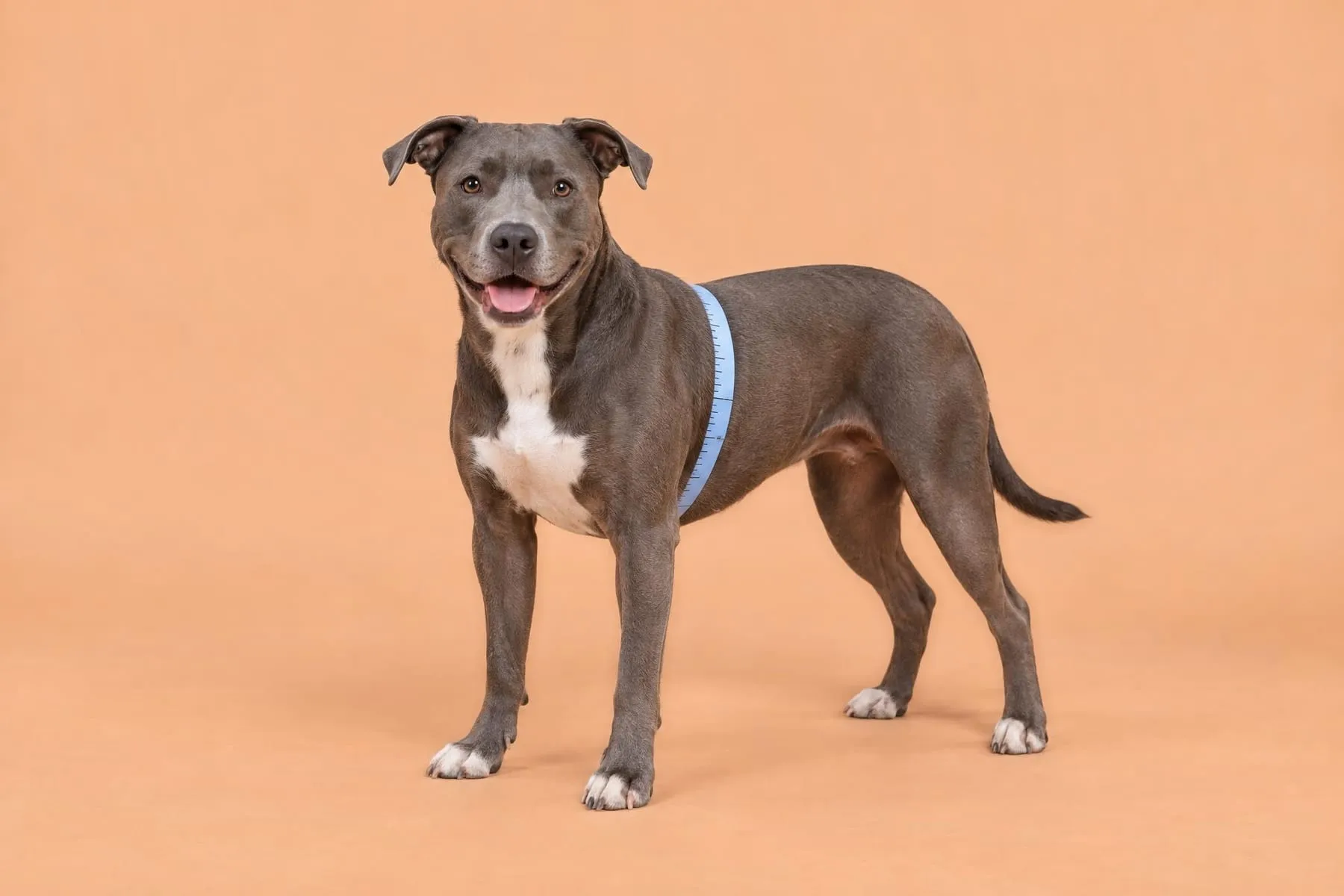
Tape the widest part of the ribcage, usually close behind the front legs. If your harness's chart marks a spot further back, measure there instead.
Wrap and read
Wrap the tape all the way around and slide two fingers under it. Then read the number where the end of the tape overlaps the rest of it.
Measure the neck
If your harness's chart gives a neck size, wrap the tape low around the neck, where a collar would sit. Fit two fingers under it, then read the number.
Match the chart
Find the size whose range holds your chest number, and check the neck number fits that size too. If you land in two sizes, follow that brand's advice for dogs in between.
Fit the harness
Buckle the harness on and make sure two fingers fit under every strap. Check that the strap around the ribs rests back from the armpits and doesn't press into them.
Watch a walk
Walk your dog and look for a strap that digs in or shortens their stride. For the first few walks, check the skin under each strap when you get home.
Where does the tape go?
Measure around the largest part of the rib cage, which is usually close behind the front legs (AKC). Some harness charts move the tape further back, to a couple of inches behind the elbow. The elbow is the bony point at the back of the front leg, where the leg meets the chest.
Those are two different places on your dog, so one number won’t suit every chart. Always tape where your harness’s own chart asks. If you’re comparing two harnesses, measure at each spot and label each number, because a size in one brand may not match the same size in another (AKC).
How snug should the tape be?
Pull the tape so it lies flat against your dog all the way around, then slide two fingers under it before you read the number. That two-finger gap adds a little slack to the measurement (AKC). Measure with your dog standing up, so their back is straight and their weight is even.
If your dog keeps turning around to sniff the tape, it’s easier with a second person. One of you holds a treat at nose height while the other wraps.
Do you need to measure the neck?
Some harness charts give each size a neck range as well as a chest range. Measure the neck low down, where a collar would sit, starting near the withers, the ridge between your dog’s shoulder blades (AKC). Use the same two-finger gap as you did for the chest.
If your chart asks for both, check that your two numbers land in the same size. Pickle, my pug, has a neck nearly as thick as his chest, and on a dog built like that the neck can be the number that decides it. Our Fit Finder asks for both numbers, and it tells you when the neck doesn’t fit the size your dog’s chest measurement gives.
What if your number fits two sizes?
The AKC’s rule is to go up a size when in doubt, but harness brands don’t all agree. Some also tell you to choose the larger size, while others ask for the smallest size your dog still fits comfortably. Follow the chart of the harness you’re buying, because its advice is about its own sizes. That goes for front-clip harnesses too (Best Friends Animal Society).
On some charts the sizes overlap so much that your number can land inside two or even three of them. Our Blue-9 Balance Harness review explains how to choose a size when your number fits more than one.
How do you know the harness fits?
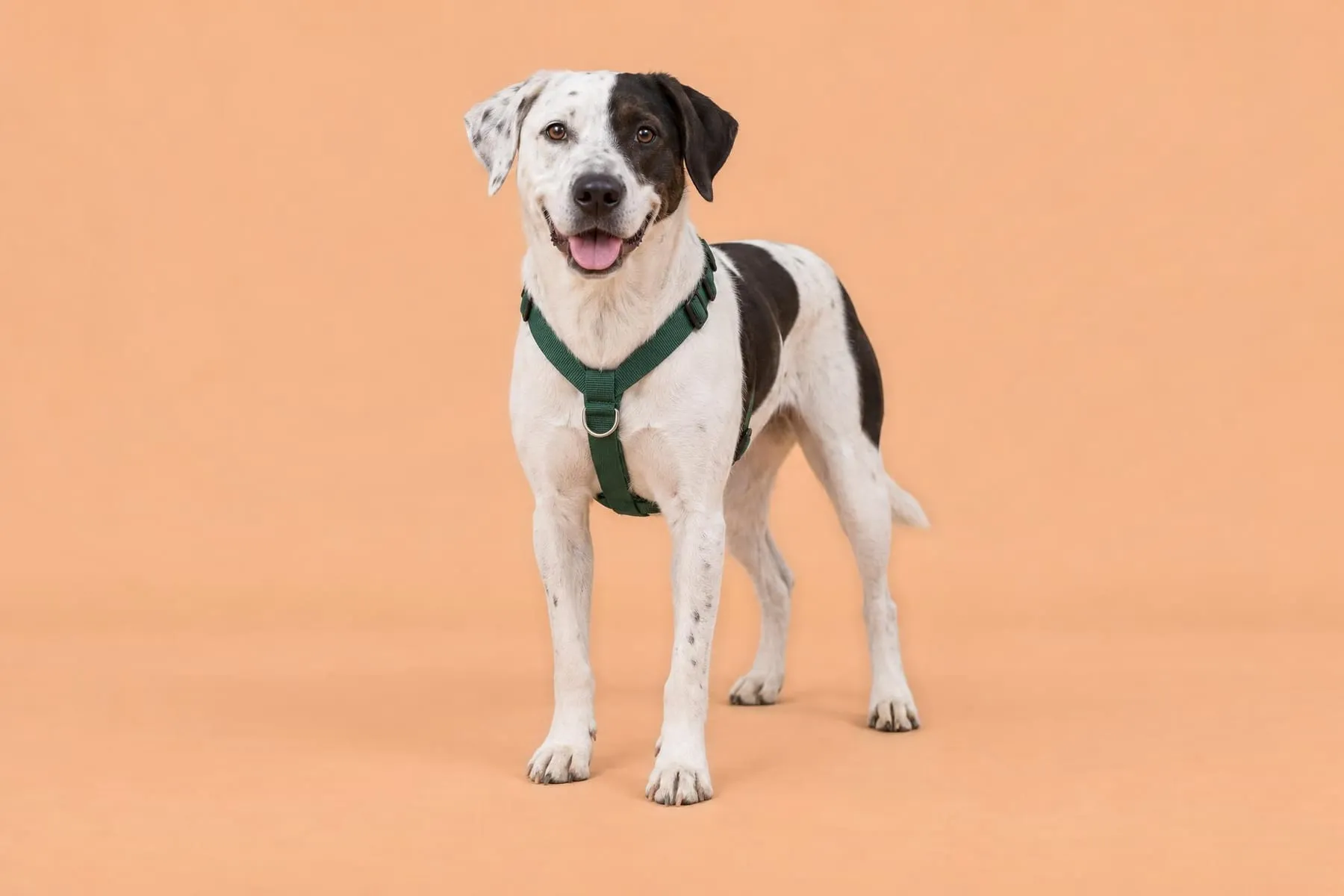
With your dog standing, adjust the harness until you can slide two fingers under every strap. Then check the strap that circles the ribs behind the elbows, which shouldn’t rub at the armpits or the elbows (Edmonton Humane Society).
Next, watch your dog’s walk and posture in the harness. If a strap digs in or holds them back, adjust it, and take a full walk around the block to check. Our guide on how to fit a dog harness takes you through each strap and the signs that one is rubbing.
When should you take it off and see your vet?
For the first few walks, check the skin under the straps when you get home. Look most closely across the chest and under the front legs, because front-clip harnesses in particular can cause chafing (Best Friends Animal Society). If you find red skin, a scab, a bald patch or an open sore, leave the harness off and call your vet (ASPCA).
Measure for the chart you’re buying from
A tape measure gives you a number, and the chart turns it into a size. That’s why this page keeps sending you back to the chart of the harness you’re buying. It says where to measure, and which size to choose when your dog falls between two.
Whether you got it right shows up later, on the walk and back home: a stride the straps don’t hold back, and no red skin underneath them.